


From Product to Solution
The 'best' product does not always make for the best solution. In mechanical and plant engineering, the interplay between components, processes, and interfaces is more important than the specifications of individual parts. This is true from procurement to implementation and is precisely where the difference between product and solution-oriented approaches, which HELU has sought after for several years, comes into play.

"One cable with the best specifications, an especially robust connector, a drag chain for demanding movements... all good decisions," outlines Andreas Muckes, Senior Product Manager Solutions. "And despite this, sometimes you end up with a machine that takes longer to assemble, is a greater burden on logistics, and is prone to failures in operation. That's because achieving technical excellence for individual components doesn't automatically mean that the system as a whole is a good return on investment." If you look at the complete application instead of individual products, you surprisingly often will find easy ways to improve efficiency.
Why a focus on products just doesn’t cut it
In development projects, mechanical and plant engineers typically make decisions consequentially based on individual products. Which cable fits here? Which drag chain do I need? Which gland? The goals of those involved may also vary significantly. Engineers rely on proven modules and quick development times. Purchasing prefers interchangeable parts at low unit prices. Manufacturing focuses on established processes. These exact interfaces are where the greatest potential can be found.
With cables, in particular, there is room for a lot more flexibility than most would think. Electrical requirements are often precisely prescribed, and the actual drivers of costs lie in mechanics, material selection, environmental conditions, and approvals. A cable with an identical electrical construction (e.g., 18 G 0.75) can cost €2.65/m for permanent installation, €4.12/m for average drag chain applications, or €7.69/m for high-end applications. This is a difference of roughly 290 per cent. On top of this, there are additional costs such as sheath materials (PUR instead of PVC) or normative requirements such as for a UL approval. "It makes sense to select the perfect solution for the type of movement and the environment of the actual application instead of automatically selecting the one with the highest specifications," explains Muckes.
Simplicity in energy transmission
Cable runs include components ranging from cable ties, trays, and corrugated tubes to drag chains in a variety of designs. The largest impact on cost typically comes from the simple question of whether an application needs a drag chain. If the application only moves a few centimetres in a straight line, then a corrugated tube will suffice, or sometimes no guidance is necessary at all.
If a drag chain is required, it pays to look at the details: open or closed, robust or light-weight? It depends on what kind of stability and coverage are really required.
With metal chips, protection is necessary, however with wooden chips, an open design can even be advantageous. "The decision between steel and plastic isn't a matter of principle, but a decision that must be made on a case-by-case basis. This is precisely where you'll find the value in a systems supplier that can do both," adds Muckes.
Take advantage of a solution check!
Fewer parts, less work
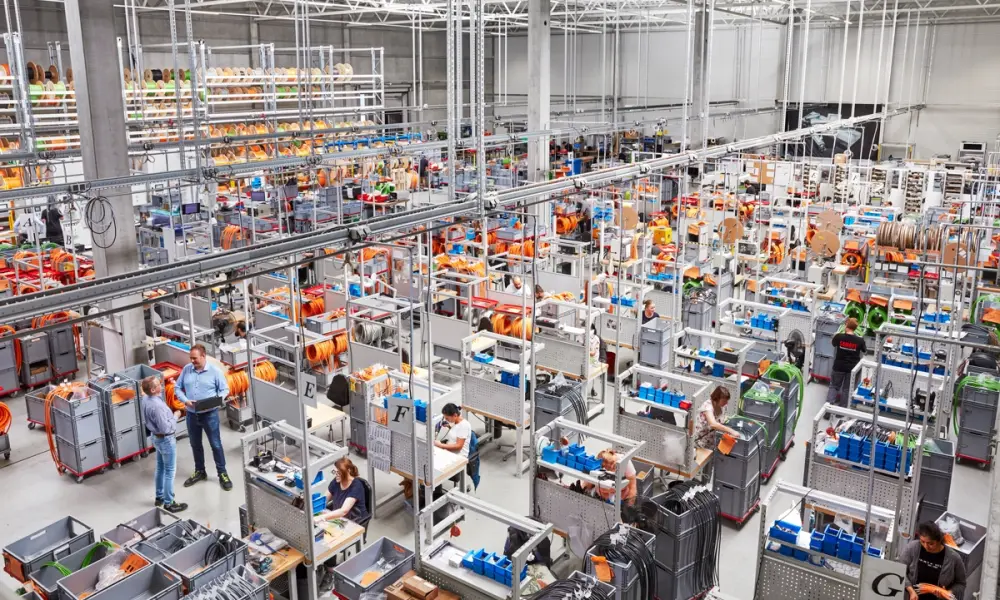
Cable assembly at HELU Connectivity Solutions in Bielefeld.
Costs are not only incurred for materials—they are also incurred in processing. Parts need to be entered, supplies must be planned and ordered, received goods checked and distributed internally, often from multiple suppliers. Even a 'simple' drag chain with plugs, glands, and cables can quickly exceed 100 positions. Warehouse and provisioning concepts also have an impact on expenditures and error rates, or whether cables are stored on drums or in rings, whether they are cut in the warehouse or in the manufacturing line, and whether they are made available individually or as a set. Andreas Muckes is convinced that, "if you really evaluate material flows and variations, you'll quickly find ways you could potentially save money."
Cable assemblies—combined cables and connectors—present tangible advantages for processing and inspections. "A typical round connector can be easily installed by a trained professional, but it still takes between 20 to 30 minutes to complete," explains Christian Gladis, Senior Project Manager Solutions at HELU. "In manufacturing environments that are specifically designed for this, it can be done significantly quicker and with greater consistency."
Testing is just as important. Hardly any machine or plant manufacturer is able to test every cable they have assembled themselves before installation. Professionally manufactured cables, on the other hand, are thoroughly tested for logic and overvoltage, and bus cables are subjected to data transmission tests with included documentation. "This makes troubleshooting and approval during installation easier," Gladis emphasises.
Defining shared goals
In order to implement a solution-oriented approach holistically, you must consider the different perspectives of the various teams involved. Construction wants safe, proven designs and as few iterations as possible, while purchasing concentrates primarily on standardisation, availability, and unit prices. Production, on the other hand, requires realistically obtainable stable processes, tools, expertise, and cycle times. "Each perspective is valid, but when combined, they may, in the worst case, lead to contradictions," adds Andreas Muckes. "A technically exceptional component may fulfil the requirements listed in the specification sheet but may lead to increased expenditures down the line due to there being too many variations, having complicated installation procedures, or resulting in connections that are difficult to inspect."
Download our free white paper now!
Systems competency for ideal solutions
This is where systems competency shows its true value. When the application, environment, and process goals are considered together, alternatives can be evaluated early on before they become too expensive. This does not mean that everything needs to be reinvented, it means consolidating the important questions: where do pre-assembled modules really shine? What variations are technically 'nice to have', but may lead to different additional expenditures elsewhere? And where can complexity be reduced without sacrificing flexibility? "Here, we can act as an external and neutral sparring partner. One who has real, comprehensive experience with similar applications and a well-trained eye for complete systems," Muckes says.
The shift from a product-based approach to a solutions-based one opens up new options when it comes to selecting components and designing processes. It is not about purchasing everything pre-assembled or doing everything yourself but creating flexible and practical solutions to real challenges. "We want to support users with our expertise in electrical connection technology," Muckes affirms. "Our goal is to really understand what's causing problems and to develop a solution that provides our customers with the greatest value possible."
You can also read this and many other fascinating articles in the latest issue (#19) of our magazine, POWER.